Compiled and written by George Urbaszek
Welcome to all new subscribers. This newsletter is continually gaining more following. If you wish to submit articles or jokes, or want to advertise bass-related services, please email me at Creative Bass to submit your material.
Why did the bass player get mad at the timpanist?
He turned a peg and wouldn't tell the bass player which one.
Although the above is one version a popular bass player joke, I have included
it in this month's newsletter anyway, just in case you have not heard it. Moreover,
I have encountered a very similar situation myself. It was about 30 years ago
when I was a music student. My bass playing colleague, Joerg, and myself went
to a jazz gig of another bass playing colleague, Martin, in the city of Mainz
in Germany. In the break, Joerg turned one of the pegs on Martin's bass quite
considerably. Martin played most of the next set without showing any signs of
unease at all. And to top it off, Joerg and I noticed no intonation flaws at
all. We were amazed. At some stage, Martin easily re-tuned the string in the
middle of a song. When we quizzed him about the situation in the next break,
Martin said it only mildly bothered him when playing the open string, which
is when he re-tuned. So was the joke on Joerg and me, the ones in the know?
I think so. I certainly learned a lesson that day. And that was that using your
ears for intonation is most important. Martin definitely has great ears!
On another personal note, gigs this month have been mostly Jazz and Groove with The Channon Jazz Collective. Upcoming gigs are almost taking an about-turn in the direction of Country, Zydeco, Irish and Reggae with Thrillbilly Stomp. Website Thrillbilly Stomp In addition to the groove aspect, I enjoy having the freedom to play more-than-usual melodic bass. To end 2006 Thrillbilly Stomp will be performing at the Bangalow Hotel in Bangalow on Saturday 30 December, 8-11pm, and at the Slipway Hotel in Ballina on Sunday 31 December, 6-9pm, on the North Coast of New South Wales, Australia. Following the Ballina gig we are off to the Rosebank Hall to perform after The Romaniacs and bring in the New Year.
Speaking of New Year, I wish you peace and joy throughout and forever. Keep the bass groovin’.
The lesson in this month’s newsletter is on the topic of reading, music reading, that is. The universal language of music can also be notated in a universal way. Just like music itself, once you understand its notation, many more avenues will be available to you.
Reading
I’m sure there are numerous readers of this newsletter who cannot interpret music notation examples. Well, help is on the way, right here and now.
If you want to pick up more ideas, it is important to be able to read music. Reading will also get you at least twice as much work. This is especially important if you aspire to be a professional musician. Colleagues, students, and myself are often booked for gigs which involve only very little reading (but lots of improvising). If we were not able to read music, we would be excluded from these gigs which generally lead to further jobs and new contacts. These new gigs may not involve reading at all, but we wouldn’t be there if we couldn’t read in the first place. See what I’m getting at? Don’t interrupt a likely chain of positive musical events through preconceptions or laziness. Therefore, I strongly suggest you develop your reading skills.
Here are some ideas to get you started
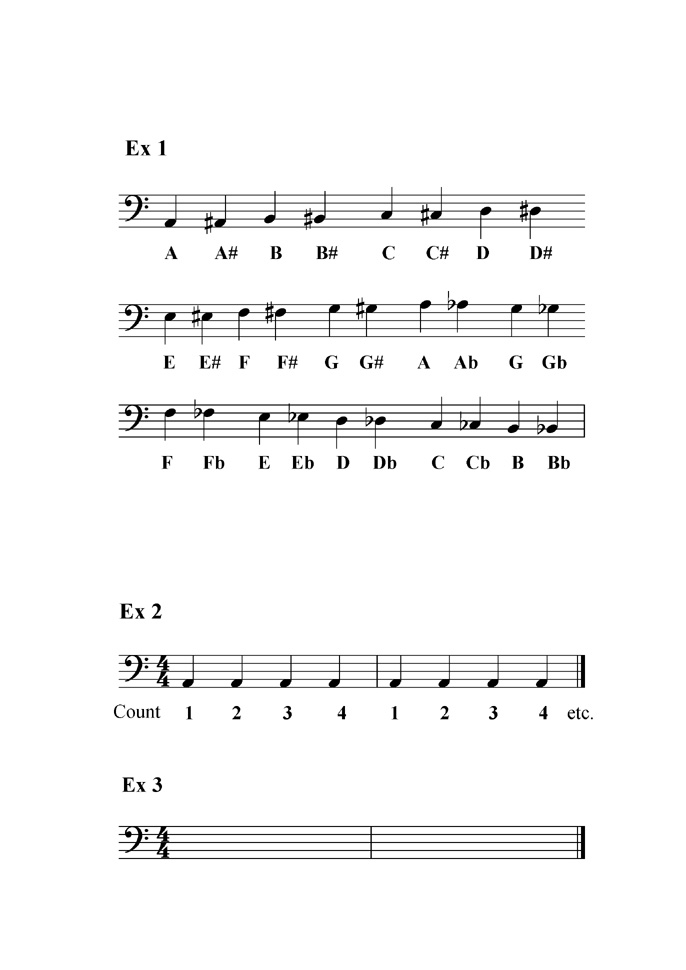
First, learn the music alphabet. It is very easy as it contains only seven letters/notes: A B C D E F G. All seven notes can be raised (higher pitch) by a semitone (one fret on the bass guitar) making the notes A# (# = symbol for sharp, speak A sharp) B# C# D# E# F# G#. All seven notes can also be lowered (lower pitch) by a semitone making the notes Ab (b = symbol for flat, speak A flat) Bb Cb Db Eb Fb Gb.
You must learn all notes on the fingerboard. If you haven’t already done so, get to it!
Next, learn to recognize what the music alphabet looks like in music notation.
This is just as simple.
See Ex 1 below
Of course there is more, but learn this first, then check out the “more”.
Let’s look at basic rhythm notation. In Western music the most common
time signature is four/four, symbolized by 4/4 or C for Common Time. Imagine
a bass drum pounding a steady pulse: doof, doof, doof, doof, 1, 2 ,3, 4, 1,
2, 3, 4, etc.
In Ex 2 the bass plays the note A (open A-string or 5th fret, E-string) with
the bass drum.
See Ex 2 below
These are called quarter notes as 4/4 makes a whole (bar of music in common time).
Again, there is much more, so do your own research.
Now get your bass, play a steady stream of eight quarter notes (they can be different notes) and write them in the space provided at Ex 3. Of course you will have to do a printout of this page or, alternatively, get some music manuscript paper. I highly recommend the hands-on approach of writing your own notation.
See Ex 3 below
Do this playing/writing exercise many times, always with different notes, yet use the same 1/4-note rhythm.
I trust you will be able to interpret the music notation in subsequent issues
of the Creative Bass Newsletter.
Until then ... Bass of Luck!
FOR SALE in Northern New South Wales, Australia:
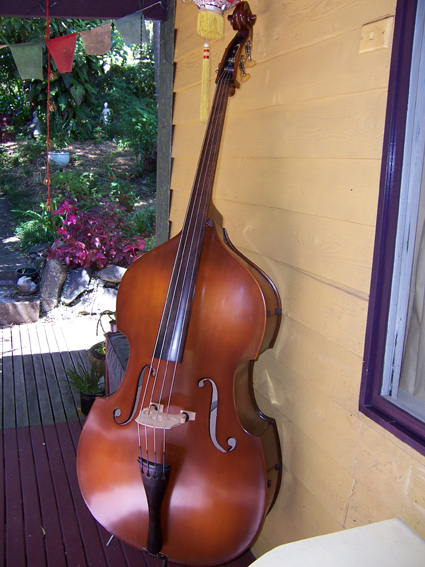
A Chinese-made double bass. This instrument is very easy to
play, due mainly to its slim neck and set-up by yours truly. All woods are solid
except the ribs, which are plywood. The bass has an ebony fingerboard. Upgrades
include bridge height adjusters and a very good endpin. The asking price is
$2900.00 AUD. Please email me at Creative
Bass or phone 02 66886143 for info.
Here is a photo
If you are not already a subscriber to Weekly Bass Lessons Online, click HERE to find out exactly how the lessons work and to check the new price and payment structure.
Serving the Bass Community,
George Urbaszek
Bass lessons are supplied by Creative Bass
A division of Creative Avenues, ABN 22 323 614
466
Physical Address: 2 Nimbin Street
The Channon, NSW 2480, Australia
Phone/Fax: 061 266886143